Early Years Toolkit
Support for the sector
Free, ready-to-use assets and messaging to promote Starting Reception.
Making the most of Starting Reception
In this section, find information specifically for professionals working in early years settings, schools and local authorities. All content is free to use and publish. We ask that you do not change the definition and credit startingreception.co.uk.
Not sure what Starting Reception is? Read our FAQs.

Customise the Starting Reception definition for your organisation
The free Starting Reception booklet
Instructions for adding your own logo to the Starting Reception booklet
- To add your logo to the PDF: We have left space for your logo on the front cover of the PDF in the top right corner. Download the document, open it in any PDF editing software and drag your logo onto the top right hand corner.
- If you are having trouble with software, please use the 'Edit PDF' function on ILovePDF (free & no registration needed). Click 'Select PDF file' and upload the Starting Reception PDF. Then select 'Add image', choose your school/organisation logo and position/resize it in the online editor. Finally, click 'Edit PDF' and then 'Download PDF'.
- To add details of local services or notes: there is a large amount of space on the back page where you can add your own text.
Content from Starting Reception which is easy to copy and paste
Dechrau’r Dosbarth Derbyn
Mae taith eich plentyn i'r ysgol yn dechrau gartref.
Rydyn ni'n deall bod pob plentyn yn datblygu ar ei gyflymder ei hun, a'n bod ni i gyd yn dysgu o’n genedigaeth. Pan ddaw'n amser dechrau'r ysgol, bydd angen mwy o help ar rai plant nag eraill.
Mae yna sgiliau allweddol* y mae ysgolion yn disgwyl i'r rhan fwyaf o blant ddechrau eu dysgu cyn eu diwrnod cyntaf. Bydd ymarfer y rhain yn gwneud taith eich plentyn i'r Dosbarth Derbyn mor gadarnhaol â phosibl.
Os yw’ch plentyn eisoes mewn meithrinfa, mewn lleoliad cyn-ysgol, neu gyda gwarchodwr plant, bydd y gweithwyr proffesiynol hyn yn gweithio gyda chi a'ch plentyn i'w helpu i baratoi.
Mae llawer o bethau y gallwch eu gwneud gartref i adeiladu hyder ac annibyniaeth eich plentyn, gan ei helpu i deimlo'n barod yn emosiynol ac yn ymarferol i ddechrau'r ysgol.
*Rydyn yn galw'r ddogfen hon yn ddiffiniad 'Dechrau’r Dosbarth Derbyn'. Mae rhai pobl/sefydliadau yn cyfeirio at hyn fel 'parodrwydd ar gyfer yr ysgol'.
Sut allaf i helpu fy mhlentyn i baratoi?
- Bydd eich plentyn yn cael llawer o weithgareddau ac arferion newydd i ddod i arfer â nhw pan fydd yn dechrau yn yr ysgol. Mae rhai pethau y bydd angen iddo ei wneud yn fwy annibynnol nag o'r blaen.
- Research shows that a child’s relationship with their parents is the most important factor in their development, and there’s a lot you can do at home.
- Pan fydd eich plentyn gartref gyda chi neu ofalwr arall, gallwch ymarfer fel teulu gyda gweithgareddau hwyliog (rydyn wedi cynnwys dolenni ar ddiwedd yr adnodd hwn).
- Mae rhai o'r sgiliau hyn yn cymryd amser i'w meistroli, felly mae'n dda eu cyflwyno nhw'n raddol fel rhan o'ch trefn ddyddiol.
Beth os oes gan fy mhlentyn anghenion ychwanegol?
- Os oes angen cymorth ychwanegol ar eich plentyn i ymgartrefu yn y Dosbarth Derbyn, gwnewch yn siŵr eich bod yn rhannu cymaint o wybodaeth â phosibl â’i athro/athrawes newydd. Gallant weithio gyda chi i ddod o hyd i strategaethau i gefnogi eich plentyn.
- Efallai y bydd angen mwy o gymorth ar blant a aned yn yr haf, neu’r rhai sy’n siarad Saesneg/Cymraeg fel iaith ychwanegol (S/CIY).
- Os ydych chi'n gwybod neu'n amau bod gan eich plentyn anghenion addysgol arbennig (AAA), gwahaniaethau datblygiadol neu oedi, efallai na fydd rhai o'r sgiliau hyn yn gyraeddadwy iddo ar hyn o bryd.
- Mae cymorth cynnar yn gwneud gwahaniaeth mawr – gofynnwch i feithrinfa eich plentyn, ei ysgol, ei ymwelydd iechyd, y ganolfan blant leol neu ganolfan deuluol am help.
Gyda phwy allaf fi siarad er mwyn cael cymorth?
Mae angen cymorth ar bob plentyn gan yr oedolion y maent yn ymddiried ynddynt i deimlo’n hyderus ac yn gyffrous am ddechrau’r Dosbarth Derbyn.
- Gall eich gwarchodwr plant/meithrinfa/tîm cyn-ysgol neu eich ymwelydd iechyd, canolfan blant neu ganolfan deulu helpu os oes angen rhagor o wybodaeth arnoch.
- Rydyn hefyd wedi llunio rhestr o sefydliadau ac adnoddau ymhellach i lawr i'ch helpu chi a'ch plentyn i baratoi gyda'ch gilydd.
The definition: skills to practice before starting Reception
New skills take time to learn. Practicing at home will help your child move into school more easily and with confidence.
Annibyniaeth gynyddol
Gofalu am ei hun
- Gwisgo/tynnu ei gôt a'i esgidiau
- Defnyddio'r toiled a golchi ei ddwylo
- Gwisgo heb fawr o help, e.e. ar ôl defnyddio'r toiled neu wneud ymarfer corff
- Defnyddio cyllyll a ffyrc (e.e. fforc a llwy, gweill bwyta) ac yfed o gwpan agored
- Treulio amser i ffwrdd oddi wrthych, yn dysgu y gall oedolion gofalgar ofalu amdano
Chwarae, creadigrwydd a chwilfrydedd
- Cymryd rhan mewn chwarae llawn dychymyg (e.e. chwarae rôl)
- Arlunio, paentio, lliwio a gludo
- Counting, building and doing puzzles
- Rhannu llyfrau stori, edrych ar luniau a siarad am y cymeriadau
- Exploring the world around them (e.g. looking closely at the natural world, noticing numbers, patterns and shapes, playing safely with objects at home)
Meithrin perthnasoedd a chyfathrebu
Bod gydag eraill
- Ymarfer rhannu a chymryd tro gyda theganau
- Siarad ag ef ynglŷn â sut mae’n teimlo a pham
- Mae edrych ar lyfrau stori gyda’ch gilydd a siarad am yr hyn y mae cymeriadau yn ei deimlo yn ffordd dda o wneud hyn
- Dechrau adnabod beth mae eraill yn ei deimlo, e.e. deall os yw ffrind yn drist
- Ei annog i osod ffiniau iddo ef ei hun ac eraill (e.e. gwybod sut i ddweud 'na')
Cyfathrebu ac iaith
- Cyd-ganu gyda chaneuon a hwiangerddi
- Siarad yn hapus ag eraill am weithgareddau, profiadau a'r byd o'u cwmpas
- Dangos bod angen cymorth arnynt drwy siarad yn glir (mewn Saesneg/Cymraeg sylfaenol neu iaith arwyddion)
- Adnabod patrwm ei enw (fel y gall ddod o hyd iddo ar ei beg cotiau neu siacedi)
Gwrando ac ymgysylltu
- Talu sylw am gyfnodau byr
- Gwrando ar gyfarwyddiadau syml a'u dilyn
- Parhau â thasg hyd yn oed pan mae'n anodd a bownsio'n ôl os aiff pethau o chwith
Datblygiad corfforol
Symud am o leiaf tair awr y dydd
- Cerdded i fyny ac i lawr grisiau (un droed ar y tro, gan ddefnyddio'r wal am gymorth)
- Dringo, rhedeg, neidio a chwarae
- Dal pêl fawr (y rhan fwyaf o'r amser)
- Gwneud posau syml a gweithgareddau crefft, gan gryfhau ei afael gyda thorri a gludo
Arferion iach
- Mynd i'r gwely tua'r un amser bob nos, deffro mewn pryd i baratoi ar gyfer yr ysgol
- Cyfyngu amser sgrin i'r symiau dyddiol a argymhellir (gweler y cyngor)
- Bwyta diet iach a rhoi cynnig ar fwydydd newydd
- Brwsio ei ddannedd â phast dannedd fflworid ddwywaith y dydd (bydd angen i chi oruchwylio hyn nes ei fod yn 7 oed o leiaf)
Beth ddylwn i ei wneud os oes gennyf bryderon am ddatblygiad fy mhlentyn?
- Os ydych chi'n poeni am gynnydd eich plentyn, siaradwch â'ch gwarchodwr plant/meithrinfa/tîm cyn-ysgol, ymwelydd iechyd, canolfan blant leol neu ganolfan deuluol.
- Os oes gan eich plentyn oedi datblygiadol neu AAA (a amheuir neu wedi’i gadarnhau), siaradwch â’i feithrinfa, gwarchodwr plant, neu ymwelydd iechyd/tîm cyn-ysgol ymhell cyn iddo ddechrau yn y Dosbarth Derbyn a thrafodwch ei anghenion pan fyddwch yn dewis ysgolion.
- Gallwch weithio gyda lleoliad blynyddoedd cynnar eich plentyn i helpu'ch plentyn gyda hunanofal, rheoli emosiynau, sgiliau cymdeithasol a chyfathrebu mewn ffordd sy'n addas ar gyfer ei gyfnod datblygu.
- Efallai yr hoffech chi rannu manylion am: ei ddatblygiad, ei anghenion, beth sy'n ei gymell, beth allai achosi anawsterau, sut mae'n dysgu orau, a pha strategaethau sy'n gweithio'n dda.
- Gwnewch yn siŵr eich bod yn rhannu gwybodaeth bwysig â phawb sy’n cefnogi’ch plentyn, gan gynnwys ei athro/athrawes dosbarth Derbyn newydd.
Adnoddau i deuluoedd ag anghenion ychwanegol:
Mae llawer o sefydliadau a all eich cefnogi gyda gwybodaeth a strategaethau i'ch paratoi chi, eich plentyn a'i leoliad addysgol, gan sicrhau trosglwyddiad llyfn a'u paratoi ar gyfer llwyddiant yn y dyfodol.
Mae'r rhain yn cynnwys:
<h1>Dechrau’r Dosbarth Derbyn</h1>
<h2>Mae taith eich plentyn i'r ysgol yn dechrau gartref.</h2>
<p>Rydyn ni'n deall bod pob plentyn yn datblygu ar ei gyflymder ei hun, a'n bod ni i gyd yn dysgu o’n genedigaeth. Pan ddaw'n amser dechrau'r ysgol, bydd angen mwy o help ar rai plant nag eraill.</p>
<p>Mae yna sgiliau allweddol* y mae ysgolion yn disgwyl i'r rhan fwyaf o blant ddechrau eu dysgu cyn eu diwrnod cyntaf. Bydd ymarfer y rhain yn gwneud taith eich plentyn i'r Dosbarth Derbyn mor gadarnhaol â phosibl.</p>
<p>Os yw’ch plentyn eisoes mewn meithrinfa, mewn lleoliad cyn-ysgol, neu gyda gwarchodwr plant, bydd y gweithwyr proffesiynol hyn yn gweithio gyda chi a'ch plentyn i'w helpu i baratoi.</p>
<p>Mae llawer o bethau y gallwch eu gwneud gartref i adeiladu hyder ac annibyniaeth eich plentyn, gan ei helpu i deimlo'n barod yn emosiynol ac yn ymarferol i ddechrau'r ysgol.</p>
<em>*We are calling this document the ‘Starting Reception’ definition. Some people/organisations refer to this as ‘school readiness’.</em>
<p>
<strong>Sut allaf i helpu fy mhlentyn i baratoi?</strong>
<ul>
<li>Your child will have lots of new activities and routines to get used to when they start school. There are some things they’ll need to do more independently than they might have before.</li>
<li>Research shows that a child’s relationship with their parents is the most important factor in their development, and there’s a lot you can do at home.</li>
<li>When your child is at home with you or another caregiver, you can practise as a family with fun activities (we’ve included links at the end of this resource).</li>
<li>Some of these skills take time to master, so it’s good to introduce them gradually as part of your daily routine.</li>
</ul>
<strong>Beth os oes gan fy mhlentyn anghenion ychwanegol?</strong>
<ul>
<li>If your child needs additional support to settle into Reception, make sure you share as much information as possible with their new teacher. They can work with you to find strategies to support your child.</li>
<li>Summer born children, or those speaking English as an additional language (EAL) may need more support.</li>
<li>If you know or suspect your child has special educational needs (SEND), developmental differences or delays, some of these skills may not be achievable for them at this point.</li>
<li>Early support makes a big difference – ask your child’s nursery, school, health visitor, local children’s centre or family hub for help.</li>
</ul>
<strong>Gyda phwy allaf fi siarad er mwyn cael cymorth?</strong>
Mae angen cymorth ar bob plentyn gan yr oedolion y maent yn ymddiried ynddynt i deimlo’n hyderus ac yn gyffrous am ddechrau’r Dosbarth Derbyn.
<ul>
<li>Your childminder/nursery/pre-school team or your health visitor, children’s centre or family hub can help if you need more information.</li>
<li>We’ve also put together a list of organisations and resources further down to help you and your child get ready together.</li>
</ul>
<strong>The definition: skills to practice before starting Reception</strong>
<p>New skills take time to learn. Practicing at home will help your child move into school more easily and with confidence.</p>
<h3>Annibyniaeth gynyddol</h3>
<strong>Gofalu am ei hun</strong>
<ul>
<li>Putting on/taking off their coat and shoes</li>
<li>Using the toilet and washing their hands</li>
<li>Getting dressed with little help, e.g. after using the toilet or doing PE</li>
<li>Using cutlery (e.g. fork and spoon, chopsticks) and drinking from an open cup</li>
<li>Spending time away from you, learning they can be looked after by caring adults</li>
</ul>
<strong>Chwarae, creadigrwydd a chwilfrydedd</strong>
<ul>
<li>Taking part in imaginative play (e.g. role play)</li>
<li>Drawing, painting, colouring and sticking</li>
<li>Counting, building and doing puzzles</li>
<li>Sharing story books with caregivers, looking at pictures and talking about the characters</li>
<li>Exploring the world around them (e.g. looking closely at the natural world, noticing numbers, patterns and shapes, playing safely with objects at home)</li>
</ul>
<h3>Meithrin perthnasoedd a chyfathrebu</h3>
<strong>Bod gydag eraill</strong>
<ul>
<li>Practising sharing and taking turns with toys</li>
<li>Talking to them about how they are feeling and why</li>
<li>Looking at story books together and speaking about what characters are feeling is a good way to do this</li>
<li>Beginning to recognise what others are feeling, e.g. understanding if a friend is sad</li>
<li>Encouraging them to set boundaries for themselves and others (e.g. knowing how to say ‘no’)</li>
</ul>
<strong>Cyfathrebu ac iaith</strong>
<ul>
<li>Singing along with songs and nursery rhymes</li>
<li>Talking happily to others about activities, experiences and the world around them</li>
<li>Showing they need help by speaking clearly (in basic English or sign language)</li>
<li>Recognising the pattern of their name (so they can find it on their coat peg or jacket)</li>
</ul>
<strong>Gwrando ac ymgysylltu</strong>
<ul>
<li>Paying attention for short periods of time</li>
<li>Listening to and following simple instructions</li>
<li>Carrying on with a task even when it’s difficult and bouncing back if things go wrong</li>
</ul>
<h3>Datblygiad corfforol</h3>
<strong>Symud am o leiaf tair awr y dydd</strong>
<ul>
<li>Walking up and down steps (one foot at a time, using the wall for support)</li>
<li>Climbing, running, jumping and playing</li>
<li>Catching a large ball (most of the time)</li>
<li>Doing simple puzzles and craft activities, strengthening their grip with cutting and sticking</li>
</ul>
<h3>Arferion iach</h3>
<ul>
<li>Going to bed around the same time each night, waking up in time to get ready for school</li>
<li>Limiting screen time to the recommended daily amounts (see advice)</li>
<li>Eating a healthy diet and trying new foods</li>
<li>Brushing their teeth with fluoride toothpaste twice a day (you’ll need to supervise this until they are at least 7)</li>
</ul>
<strong>Beth ddylwn i ei wneud os oes gennyf bryderon am ddatblygiad fy mhlentyn?</strong>
<ul>
<li>If you're worried about your child's progress, talk to your childminder/nursery/pre-school team, health visitor, local children's centre or Family Hub.</li>
<li>If your child has developmental delays or SEND (suspected or confirmed), speak to their nursery, childminder, or health visitor/nursery/pre-school team well before they start Reception and discuss their needs when you are selecting schools.</li>
<li>You can work with your child’s early years setting to help your child with self-care, managing emotions, social skills and communication in a way that suits their stage of development.</li>
<li>You might want to share details about: their development, needs, what motivates them, what might trigger difficulties, how they learn best, and what strategies work well.</li>
<li>Make sure you share important information with everyone supporting your child, including their new Reception teacher.</li>
</ul>
<strong>Adnoddau i deuluoedd ag anghenion ychwanegol:</strong>
<p>Mae llawer o sefydliadau a all eich cefnogi gyda gwybodaeth a strategaethau i'ch paratoi chi, eich plentyn a'i leoliad addysgol, gan sicrhau trosglwyddiad llyfn a'u paratoi ar gyfer llwyddiant yn y dyfodol.</p>
Mae'r rhain yn cynnwys:
<ul>
<li><a href="https://www.familylives.org.uk/">Family Lives</a></li>
<li><a href="https://speechandlanguage.org.uk/">Speech and Language UK</a></li>
<li><a href="https://dingley.org.uk/">Dingley’s Promise</a></li>
<li><a href="https://www.kids.org.uk/">KIDS</a></li>
</ul>
Annibyniaeth gynyddol
Annibyniaeth gynyddol
- Edrychwch ar hwb cyngor a chylchgrawn ar-lein Parentkind i rieni 'Byddwch yn Barod am yr Ysgol' (ParentKind)
- Mwynhewch 5 awgrym y Cornel Teulu i helpu’ch plentyn i baratoi ar gyfer y Dosbarth Derbyn (Family Corner)
- Canllawiau i rieni ac ymarferwyr (PACEY)
- Lawrlwythwch yr ap EasyPeasy am ddim i’ch dyfais symudol i gael awgrymiadau a gweithgareddau i gefnogi profiadau magu plant bob dydd (EasyPeasy)
Gofalu am ei hun
- Sut allwch chi wneud gwahanu yn haws? (Family Corner)
- Gwisgo a pharatoi am y diwrnod (NHS)
- Gwisgo a pharatoi am y diwrnod (BBC Tiny Happy People)
Cyngor am hyfforddiant toiled syml a chefnogol:
- Mae gan y Sefydliad Ymwelwyr Iechyd gyngor ac awgrymiadau ar hyfforddiant toiled (The Institute of Health Visiting)
- Cyngor am hyfforddiant toiled syml a chefnogol (ERIC)
- Cyngor am hyfforddiant toiled syml a chefnogol (NHS)
- Cyngor am hyfforddiant toiled syml a chefnogol (Downs Syndrome UK)
Chwarae, creadigrwydd a chwilfrydedd
- 5 cam ar gyfer adeiladu'r ymennydd trwy ryngweithio yn ôl a blaen (Center on the Developing Child at Harvard University)
- Sut i ddilyn diddordeb plentyn mewn chwarae (National Literacy Trust)
- Sut i chwarae rôl gyda'ch plentyn (BBC Tiny Happy People)
- Sut i chwarae rôl gyda'ch plentyn (BBC Tiny Happy People)
- Tanio eu dychymyg gyda lluniadu (BBC Tiny Happy People)
- Beth yw gwneud marciau a pham ei fod yn bwysig ar gyfer dysgu? (PACEY)
- Rhannu llyfrau stori ar Ddiwrnod y Llyfr (BBC Tiny Happy People)
- Gweithgareddau natur i blant (BBC Tiny Happy People)
- Dysgu a chael hwyl ar y bws (BBC Tiny Happy People)
- Chwaraewch gêm o 'Beth yw'r sain yna?' - (BBC Tiny Happy People)
- Give your child the best start in maths - ECMG
- Everyday activities to help your child with maths – ECMG
- Six Fat Sausages number rhyme - BBC
Meithrin perthnasoedd a chyfathrebu
- Mae Fframwaith Llunio Ni y Ganolfan Sylfaen Frenhinol ar gyfer Plentyndod Cynnar yn amlinellu sut mae’r sgiliau hyn yn datblygu yn ystod plentyndod cynnar (The Royal Foundation)
- Awgrymiadau gorau ar gyfer mwynhau straeon gyda'ch gilydd ac argymhellion llyfrau ar gyfer dechrau yn yr ysgol (BookTrust)
Bod gydag eraill
- Dysgwch sut i gefnogi’ch plentyn i wneud ffrindiau (Family Corner)
- Deall datblygiad cymdeithasol eich plentyn (Words for Life)
- Ymarfer rhannu gyda theganau (BBC Tiny Happy People)
Cyfathrebu ac iaith
- Chi yw athro cyntaf/athrawes gyntaf eich plentyn – helpwch ef i ddysgu sut i ysgrifennu ei enw (Words for Life)
- Archwilio amrywiaeth o ddulliau o ddysgu a datblygu iaith (NHS)
- Adeiladu dychymyg ac iaith eich plentyn trwy greu straeon gyda’ch gilydd (BBC Tiny Happy People)
- Gwiriwr Cynnydd y Plentyn (Speech & Language UK)
Gwrando ac ymgysylltu
Arferion iach
Deall beth yw lefelau 'iach' o amser sgrin, yn ôl oedran:
- Canllaw Sefydliad Iechyd y Byd am amser sgrin (WHO)
- Canllawiau ar gyfer amser sgrin (Health Professionals for Safer Screens)
Cael cipolwg ar ddiogelwch y rhyngrwyd, sut mae defnyddio sgrin yn effeithio ar blant ifanc a’r amser sgrin a argymhellir
Ac i’r rhai sydd â phlant iau, mae’r NCT yn cynnwys cyngor i fabanod a phlant bach hefyd
Helpu plant i feithrin perthynas gref gyda bwyd a gwneud y dewisiadau cywir o’r dechrau:
- (Department for Education)
- (NHS)
- (BBC Tiny Happy People)
- (First Steps Nutrition Trust)
- Taflen ffeithiau ar ddiet iach i blant (Association of UK Dieticians)
Brwsio dannedd plant ac ymweld â'r deintydd:
Canllawiau am gysgu
<h2>Annibyniaeth gynyddol</h2>
<h3>Annibyniaeth gynyddol</h3>
<ul>
<li><a href="https://www.parentkind.org.uk/for-parents/be-school-ready#heading547662" target="_blank" rel="noopener">Online advice hub and magazine for parents: 'Be School Ready' - Parentkind</a></li>
<li><a href="https://www.familycorner.co.uk/5-tips-help-your-child-prepare-transition-reception" target="_blank" rel="noopener">Mwynhewch 5 awgrym y Cornel Teulu i helpu’ch plentyn i baratoi ar gyfer y Dosbarth Derbyn (Family Corner)</a></li>
<li><a href="https://www.pacey.org.uk/starting-school/" target="_blank" rel="noopener">Canllawiau i rieni ac ymarferwyr (PACEY)</a></li>
<li><a href="https://easypeasyapp.com/for-parents-and-carers" target="_blank" rel="noopener">Lawrlwythwch yr ap EasyPeasy am ddim i’ch dyfais symudol i gael awgrymiadau a gweithgareddau i gefnogi profiadau magu plant bob dydd (EasyPeasy)</a></li>
</ul>
<h3>Gofalu am ei hun</h3>
<ul>
<li><a href="https://www.familycorner.co.uk/how-do-i-make-separating-my-toddler-easier" target="_blank" rel="noopener">Sut allwch chi wneud gwahanu yn haws? (Family Corner)</a></li>
<li><a href="https://www.leicspart.nhs.uk/wp-content/uploads/2020/06/416-dressing-skills-2.pdf" target="_blank" rel="noopener">Gwisgo a pharatoi am y diwrnod (NHS)</a></li>
<li><a href="https://www.bbc.co.uk/tiny-happy-people/articles/zdxvy9q" target="_blank" rel="noopener">Gwisgo a pharatoi am y diwrnod (BBC Tiny Happy People)</a></li>
</ul>
<h3>Cyngor am hyfforddiant toiled syml a chefnogol:</h3>
<ul>
<li><a href="https://ihv.org.uk/wp-content/uploads/2015/10/PT-Toilet-training-FINAL-VERSION-17.04.23.pdf" target="_blank" rel="noopener">Mae gan y Sefydliad Ymwelwyr Iechyd gyngor ac awgrymiadau ar hyfforddiant toiled (The Institute of Health Visiting)</a></li>
<li><a href="https://eric.org.uk/potty-training/" target="_blank" rel="noopener">Cyngor am hyfforddiant toiled syml a chefnogol (ERIC)</a></li>
<li><a href="https://www.nhs.uk/conditions/baby/babys-development/potty-training-and-bedwetting/how-to-potty-train/" target="_blank" rel="noopener">Cyngor am hyfforddiant toiled syml a chefnogol (NHS)</a></li>
<li><a href="https://downsyndromeuk.co.uk/parents/toilettraining/" target="_blank" rel="noopener">Cyngor am hyfforddiant toiled syml a chefnogol (Downs Syndrome UK)</a></li>
</ul>
<h3>Chwarae, creadigrwydd a chwilfrydedd</h3>
<ul>
<li><a href="https://www.youtube.com/watch?v=KNrnZag17Ek" target="_blank" rel="noopener">5 steps for brain building through serve and return - Center on the Developing Child at Harvard University</a></li>
<li><a href="https://www.youtube.com/watch?v=uXImT5QNWpw" target="_blank" rel="noopener">Sut i ddilyn diddordeb plentyn mewn chwarae (National Literacy Trust)</a></li>
<li><a href="https://www.bbc.co.uk/tiny-happy-people/articles/zvp88xs" target="_blank" rel="noopener">Sut i chwarae rôl gyda'ch plentyn (BBC Tiny Happy People)</a></li>
<li><a href="https://www.bbc.co.uk/tiny-happy-people/articles/z6jggwx" target="_blank" rel="noopener">Sut i chwarae rôl gyda'ch plentyn (BBC Tiny Happy People)</a></li>
<li><a href="https://www.bbc.co.uk/tiny-happy-people/articles/z4j8d6f" target="_blank" rel="noopener">Tanio eu dychymyg gyda lluniadu (BBC Tiny Happy People)</a></li>
<li><a href="https://www.pacey.org.uk/mark-making/" target="_blank" rel="noopener">Beth yw gwneud marciau a pham ei fod yn bwysig ar gyfer dysgu? (PACEY)</a></li>
<li><a href="https://www.bbc.co.uk/tiny-happy-people/world-book-day" target="_blank" rel="noopener">Rhannu llyfrau stori ar Ddiwrnod y Llyfr (BBC Tiny Happy People)</a></li>
<li><a href="https://www.bbc.co.uk/tiny-happy-people/articles/zj6nsk7" target="_blank" rel="noopener">Gweithgareddau natur i blant (BBC Tiny Happy People)</a></li>
<li><a href="https://www.bbc.co.uk/tiny-happy-people/articles/zvcbgwx" target="_blank" rel="noopener">Dysgu a chael hwyl ar y bws (BBC Tiny Happy People)</a></li>
<li><a href="https://www.bbc.co.uk/tiny-happy-people/articles/znnqmfr" target="_blank" rel="noopener">Chwaraewch gêm o 'Beth yw'r sain yna?' - (BBC Tiny Happy People)</a></li>
<li><a href="https://earlymaths.org/best-start-with-maths/" target="_blank" rel="noopener">Give your child the best start in maths - ECMG</a></li>
<li><a href="https://earlymaths.org/maths-postcards-for-families/" target="_blank" rel="noopener">Everyday activities to help your child with maths – ECMG</a></li>
<li><a href="https://www.bbc.co.uk/tiny-happy-people/articles/zhbx6v4" target="_blank" rel="noopener">Six Fat Sausages number rhyme - BBC</a></li>
</ul>
<h2>Meithrin perthnasoedd a chyfathrebu</h2>
<ul>
<li><a href="https://centreforearlychildhood.org/our-work/research/the-shaping-us-framework/" target="_blank" rel="noopener">Mae Fframwaith Llunio Ni y Ganolfan Sylfaen Frenhinol ar gyfer Plentyndod Cynnar yn amlinellu sut mae’r sgiliau hyn yn datblygu yn ystod plentyndod cynnar (The Royal Foundation)</a></li>
<li><a href="https://www.booktrust.org.uk/how-we-help/parents-families/getting-ready-to-start-school/" target="_blank" rel="noopener">Awgrymiadau gorau ar gyfer mwynhau straeon gyda'ch gilydd ac argymhellion llyfrau ar gyfer dechrau yn yr ysgol (BookTrust)</a></li>
</ul>
<h3>Bod gydag eraill</h3>
<ul>
<li><a href="https://www.familycorner.co.uk/how-can-i-help-my-child-make-friends" target="_blank" rel="noopener">Dysgwch sut i gefnogi’ch plentyn i wneud ffrindiau (Family Corner)</a></li>
<li><a href="https://wordsforlife.org.uk/activities/milestones-4-year-olds/" target="_blank" rel="noopener">Deall datblygiad cymdeithasol eich plentyn (Words for Life)</a></li>
<li><a href="https://www.bbc.co.uk/tiny-happy-people/articles/zxfbg7h" target="_blank" rel="noopener">Ymarfer rhannu gyda theganau (BBC Tiny Happy People)</a></li>
</ul>
<h3>Cyfathrebu ac iaith</h3>
<ul>
<li><a href="https://wordsforlife.org.uk/parent-support/when-should-my-child-be-able-to-write-their-name/" target="_blank" rel="noopener">Chi yw athro cyntaf/athrawes gyntaf eich plentyn – helpwch ef i ddysgu sut i ysgrifennu ei enw (Words for Life)</a></li>
<li><a href="https://www.nhs.uk/start-for-life/toddler/learning-to-talk/learning-to-talk-3-to-5-years/" target="_blank" rel="noopener">Archwilio amrywiaeth o ddulliau o ddysgu a datblygu iaith (NHS)</a></li>
<li><a href="https://www.bbc.co.uk/tiny-happy-people/articles/zbkc47h" target="_blank" rel="noopener">Adeiladu dychymyg ac iaith eich plentyn trwy greu straeon gyda’ch gilydd (BBC Tiny Happy People)</a></li>
<li><a href="https://progress-checker.speechandlanguage.org.uk/" target="_blank" rel="noopener">Gwiriwr Cynnydd y Plentyn (Speech & Language UK)</a></li>
</ul>
<h3>Gwrando ac ymgysylltu</h3>
<ul>
<li><a href="https://wordsforlife.org.uk/activities/talking-to-your-child-when-out-and-about/" target="_blank" rel="noopener">Dilynwch y llwybr cerdded a siarad gyda’r Ymddiriedolaeth Llythrennedd Genedlaethol (National Literacy Trust)</a></li>
<li><a href="https://www.bbc.co.uk/tiny-happy-people/articles/zb8nydm" target="_blank" rel="noopener">Ymarfer sgiliau iaith a gwrando gartref gyda'r gemau hyn (BBC Tiny Happy People)</a></li>
<li><a href="https://www.bbc.co.uk/tiny-happy-people/articles/zgvthcw" target="_blank" rel="noopener">Ymarfer sgiliau iaith a gwrando gartref gyda'r gemau hyn (BBC Tiny Happy People)</a></li>
</ul>
<h2>Datblygiad corfforol</h2>
<ul>
<li><a href="https://www.nhs.uk/live-well/exercise/physical-activity-guidelines-children-under-five-years/" target="_blank" rel="noopener">Symud am 3 awr y dydd (NHS)</a></li>
<li><a href="https://www.youthsporttrust.org/healthymovers/families" target="_blank" rel="noopener">Cefnogwch eich plentyn i fod yn berson iach (Youth Sport Trust)</a></li>
<li><a href="https://www.youtube.com/watch?v=xjxXBZeFcmg" target="_blank" rel="noopener">Beth yw cryfder craidd a pham ei fod yn bwysig i blant?</a></li>
<li><a href="https://www.bbc.co.uk/tiny-happy-people/articles/zf8v3j6" target="_blank" rel="noopener">Gemau hwyliog i gael plant i symud (BBC Tiny Happy People)</a></li>
</ul>
<h2>Arferion iach</h2>
<h3>Deall beth yw lefelau 'iach' o amser sgrin, yn ôl oedran:</h3>
<ul>
<li><a href="https://www.who.int/news-room/detail/24-04-2019-to-grow-up-healthy-children-need-to-sit-less-and-play-more" target="_blank" rel="noopener">Canllaw Sefydliad Iechyd y Byd am amser sgrin (WHO)</a></li>
<li><a href="https://healthprofessionalsforsaferscreens.org/wp-content/uploads/2024/10/0-5_poster_HPFSS.pdf" target="_blank" rel="noopener">Canllawiau ar gyfer amser sgrin (Health Professionals for Safer Screens)</a></li>
</ul>
<h3>Cael cipolwg ar ddiogelwch y rhyngrwyd, sut mae defnyddio sgrin yn effeithio ar blant ifanc a’r amser sgrin a argymhellir</h3>
<ul>
<li><a href="https://help-for-early-years-providers.education.gov.uk/health-and-wellbeing/internet-safety" target="_blank" rel="noopener">Diogelwch rhyngrwyd ac amser sgrin a argymhellir (Department for Education)</a></li>
</ul>
<h3>Ac i’r rhai sydd â phlant iau, mae’r NCT yn cynnwys cyngor i fabanod a phlant bach hefyd</h3>
<ul>
<li><a href="https://www.nct.org.uk/information/baby-toddler/caring-for-your-baby-or-toddler/screen-time-for-babies-and-toddlers-how-much" target="_blank" rel="noopener">Amser sgrin i fabanod a phlant bach (NCT)</a></li>
</ul>
<h3>Helpu plant i feithrin perthynas gref gyda bwyd a gwneud y dewisiadau cywir o’r dechrau: </h3>
<ul>
<li><a href="https://help-for-early-years-providers.education.gov.uk/health-and-wellbeing/nutrition" target="_blank" rel="noopener">(Department for Education)</a></li>
<li><a href="https://www.nhs.uk/healthier-families/" target="_blank" rel="noopener">(NHS)</a></li>
<li><a href="https://www.bbc.co.uk/bitesize/articles/z8h7dp3" target="_blank" rel="noopener">(BBC Tiny Happy People)</a></li>
<li><a href="https://www.firststepsnutrition.org/eating-well-resources" target="_blank" rel="noopener">(First Steps Nutrition Trust)</a></li>
<li><a href="https://www.bda.uk.com/resource/healthy-eating-for-children.html" target="_blank" rel="noopener">Taflen ffeithiau ar ddiet iach i blant (Association of UK Dieticians)</a></li>
</ul>
<h3>Brwsio dannedd plant ac ymweld â'r deintydd:</h3>
<ul>
<li><a href="https://www.bbc.co.uk/tiny-happy-people/articles/z6jbydm" target="_blank" rel="noopener">(BBC Tiny Happy People)</a></li>
</ul>
<h3>Canllawiau am gysgu</h3>
<ul>
<li><a href="https://www.nhs.uk/conditions/baby/health/sleep-and-young-children/" target="_blank" rel="noopener">(NHS)</a></li>
<li><a href="https://www.bbc.co.uk/tiny-happy-people/articles/zyv6xbk" target="_blank" rel="noopener">(BBC Tiny Happy People)</a></li>
</ul>
Royalty-free illustrations
Click here to download all the images in a zip file. Alternatively click on an image below to open the full-size version, then right-click and choose 'Save Image As'.
-

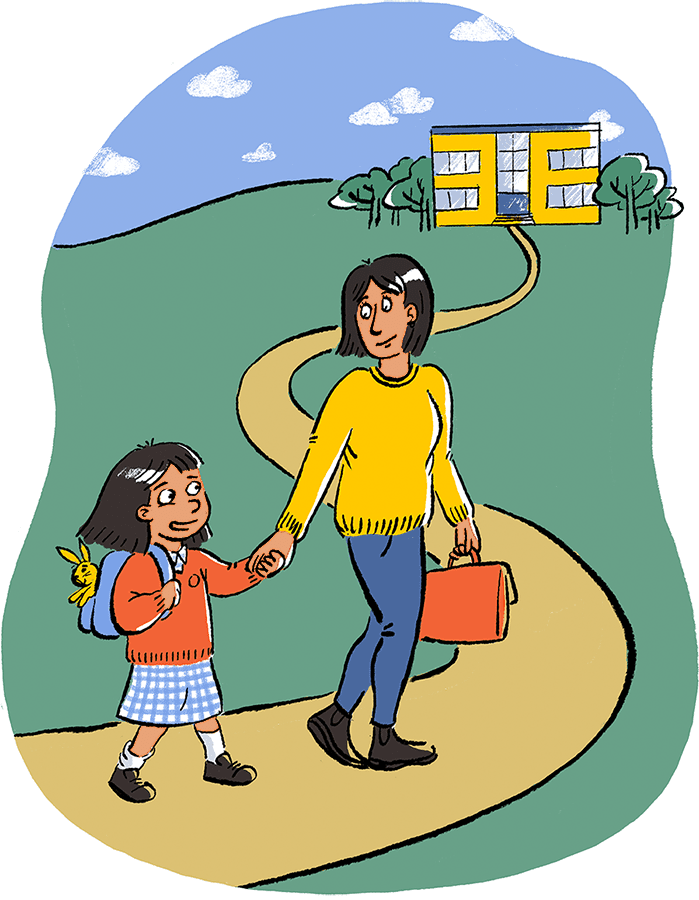
Cartoon of a parent and child on their way to school -
Cartoon of a parent and child -
Cartoon of a child singing using a wooden spoon as a pretend microphone -
Cartoon of a child eating soup while a small dog watches -
Cartoon of a child and cat building blocks -
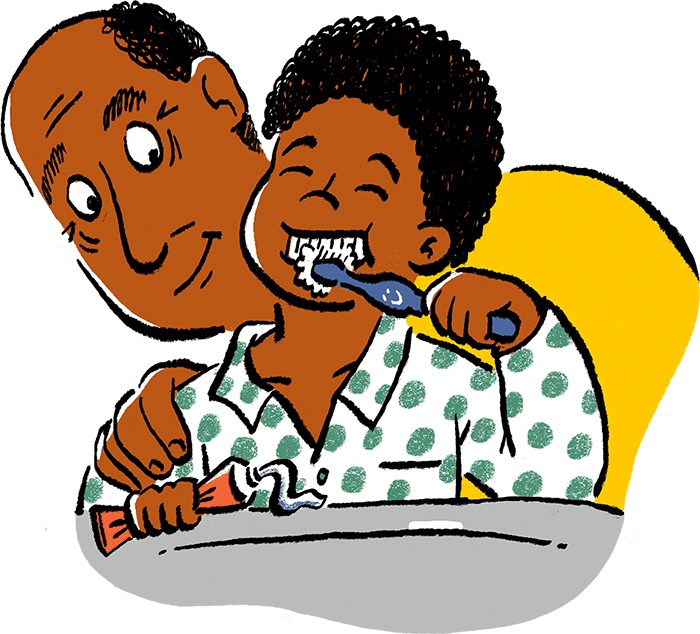
Cartoon of a child brushing teeth -
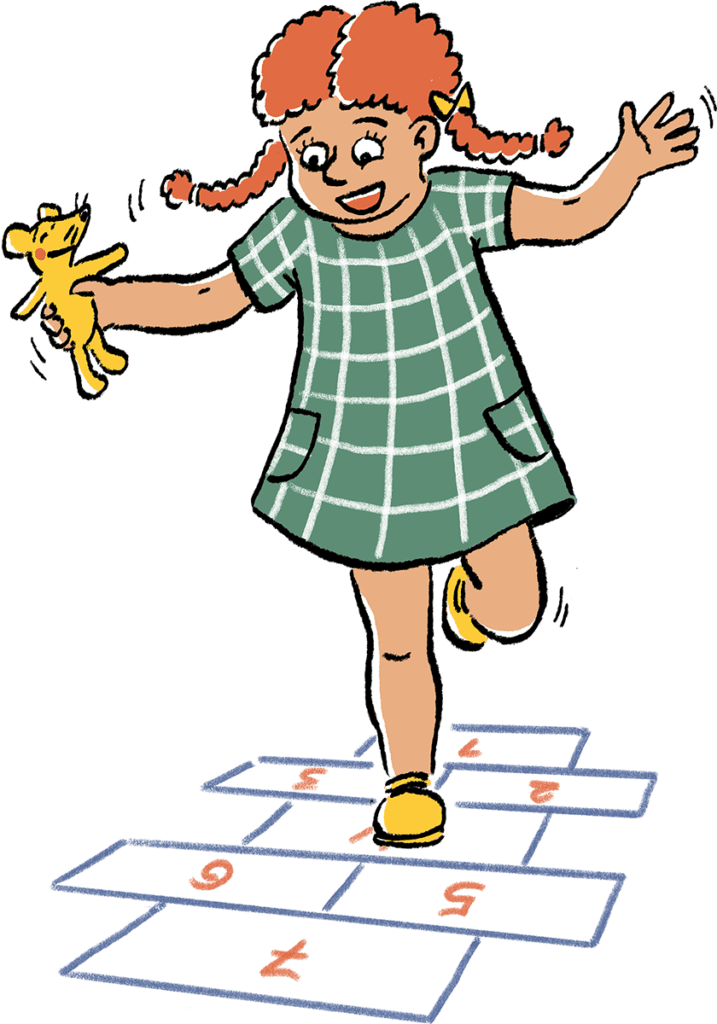
Cartoon of a child holding a toy mouse playing hopscotch -
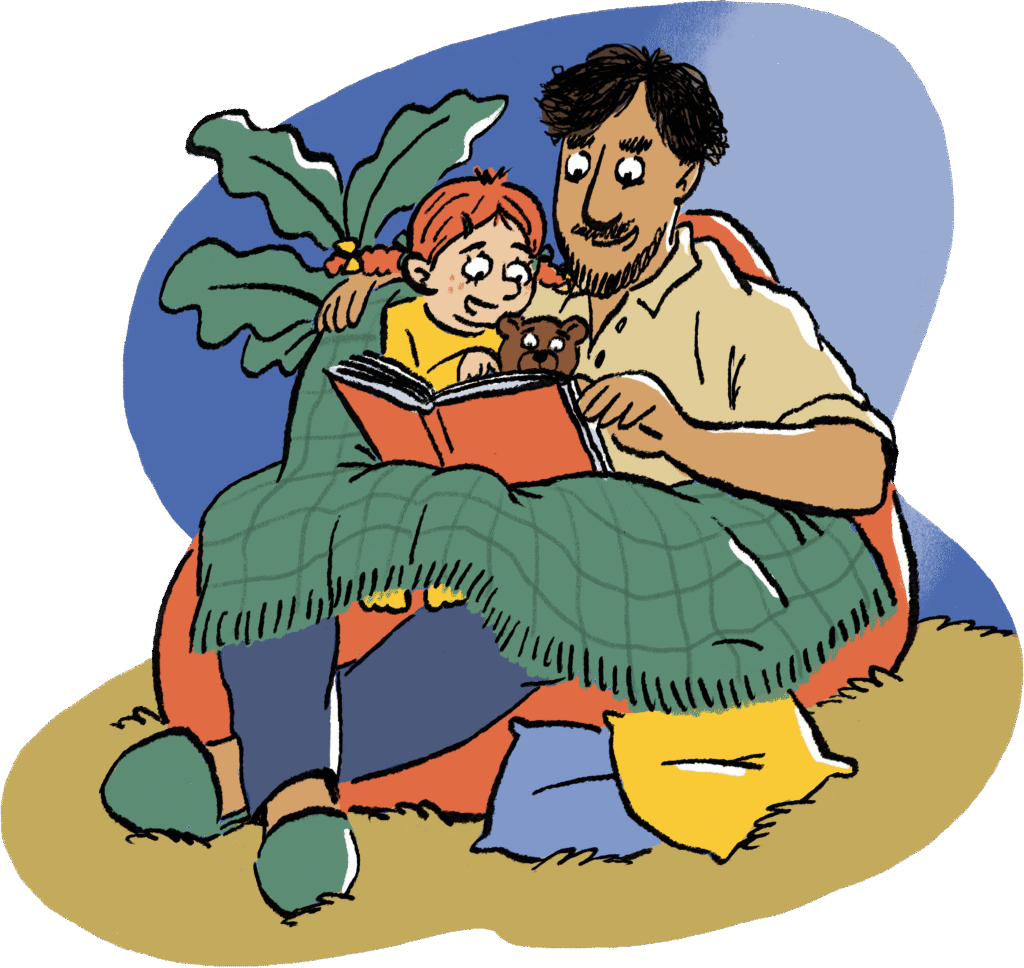
Child and parent reading together -
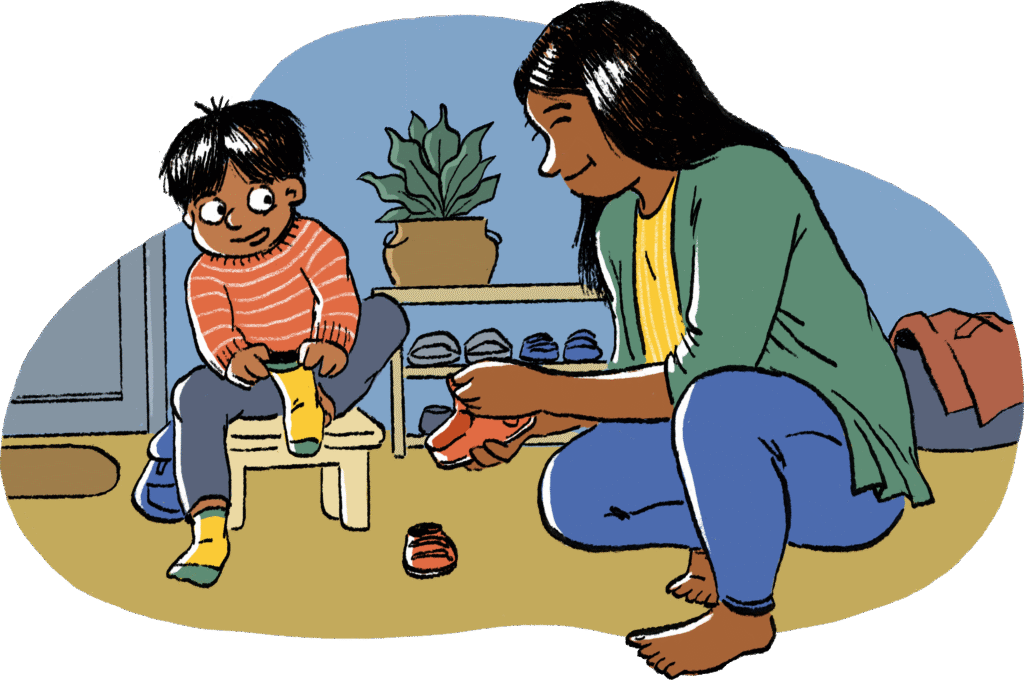
Child putting on their socks with parent supporting them



Free marketing assets
The Starting Reception A5 flyer
An editable Starting Reception poster
A QR code and template copy for emails and webpages
Starting Reception social media assets
Download the Starting Reception social media assets. The document also comes with instructions.
How to share Starting Reception with families
For nurseries, pre-schools, childminders and other early years settings
- Share Dechrau’r Dosbarth Derbyn(opens in new tab) with families on your website, in emails, newsletters and on social media. National offer day in April each year is a great opportunity to promote Starting Reception.
- Display our Starting Reception poster(opens in new tab) in your setting or create your own using our ready-made QR code.
- Print the definition (you can even add your own logo) and hand out copies to families during transition meetings and/or when children first join the pre-school room.
- Watch the 60-minute webinar(opens in new tab) and discover top tips to help strengthen your school readiness.
For schools
- Link to Dechrau’r Dosbarth Derbyn on your school website (e.g. on your admissions page).
- Include a link to Dechrau’r Dosbarth Derbyn in email communications to new families and on your social media channels.
- Print the definition (you can even add your own logo) and hand out copies to families on open days, during welcome evenings, transition visits etc...
- Display our Starting Reception poster in your school or create your own using our ready-made QR code.
- Discuss Starting Reception with feeder nurseries to align expectations and to increase awareness of any families who may be at risk and need extra support.
- Watch the 60-minute webinar and discover top tips to help strengthen your school readiness.
For local authorities
- Share Dechrau’r Dosbarth Derbyn with colleagues – health, education, social care, libraries...everyone has a role to play in helping to set clear expectations to families.
- Share Dechrau’r Dosbarth Derbyn with schools and early years settings by email and in meetings.
- Include a link to Dechrau’r Dosbarth Derbyn on the admissions pages of your website and in admissions emails.
- Print the definition (you can even add your own logo) and make copies available through schools, early years settings, family hubs, GPs and health visiting teams.
- Promote Dechrau’r Dosbarth Derbyn on your social media channels.
- Watch the 60-minute webinar and discover top tips to help strengthen your school readiness.
For libraries
- Guidance(opens in new tab) for libraries using the Starting Reception Definition.

Guidance on setting clear expectations with parents
For practitioners in early years settings
For educators in schools
Bonus Starting Reception resources to share with families
Activity Guide
Fun activity ideas to try at home to get your child ready for school.
Things I'm learning to do
Use the Starting Reception Things I'm learning to do template to encourage your child's efforts when practising the Starting Reception skills at home.
Examples of practice
Local Authorities
Find out more about how local authorities like Doncaster, Lincolnshire and Newcastle are using the Starting Reception definition here.
Schools
Find out more about how schools in Kemnal and Oasis Multi Academy Trusts are using the Starting Reception definition here.
Nurseries
Find out more about how nurseries like Ark Start are using the Starting Reception definition here.